AI Automation Database Design SQL Generation Claude AI PostgreSQL

Generate Complete Database Schemas with Claude for SQL Databases

Transform database design from weeks to minutes with this intelligent multi-agent AI system. Perfect for agencies, consultancies, and SaaS companies.

Download Template JSON · n8n compatible · Free
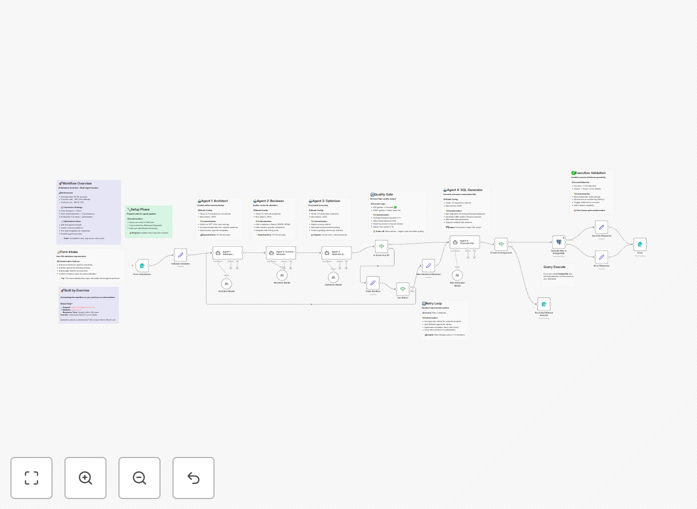
AI-powered database schema design automation workflow showing multi-agent collaboration

What This Workflow Does

Traditional database design is a complex, time-consuming process that can take weeks of expert architect time. This intelligent automation transforms that process into a matter of minutes using a sophisticated multi-agent AI system. It's specifically designed for digital agencies, technical consultancies, and SaaS companies that need to deliver high-quality database architecture quickly and consistently.

The system employs four specialized AI agents working in concert: an Architect who designs the complete schema, a Reviewer who validates for performance and security, an Optimizer who adds advanced features and scores the design, and a SQL Generator who creates production-ready migration scripts. This collaborative approach ensures every database design meets professional standards before delivery.

How It Works

Step 1: Requirement Analysis & Initial Design

The Architect agent analyzes business requirements, identifies entities and relationships, and creates a comprehensive initial schema with proper tables, indexes, and constraints. It considers data types, relationships (one-to-one, one-to-many, many-to-many), and normalization levels appropriate for the use case.

Step 2: Quality Review & Validation

The Reviewer agent examines the design for performance bottlenecks, security vulnerabilities, and scalability concerns. It checks for common issues like missing indexes, improper data types, and potential SQL injection points, providing detailed feedback with severity levels (Critical/High/Medium/Low).

Step 3: Optimization & Scoring

The Optimizer agent enhances the design with advanced features like partitioning strategies, materialized views, and performance tuning recommendations. It then scores the design (0-100) across four dimensions: Schema Quality, Performance, Scalability, and Security, assigning a letter grade.

Step 4: Smart Quality Loop

If the score falls below a B grade, the system automatically retries up to 3 times, feeding previous feedback to improve the design iteratively. This ensures consistent high-quality output regardless of initial requirements complexity.

Step 5: SQL Generation & Optional Execution

The SQL Generator creates production-ready migration scripts for PostgreSQL, MySQL, or other supported databases. The workflow can optionally execute these scripts automatically in a test environment or deliver them as downloadable files for manual review and deployment.

Who This Is For

This automation is ideal for digital agencies offering database design as a service, SaaS companies needing rapid prototyping for new features, technical consultancies creating lead magnets, developers modernizing legacy systems, and startups validating data models before development. It's particularly valuable for businesses that handle multiple database design projects and need to maintain consistent quality while scaling their delivery capacity.

Pro tip: Use this workflow as a lead generation tool. Offer free database architecture reviews to potential clients, then upsell to full implementation, custom automations, and ongoing optimization services. The automated design process creates immediate value that converts prospects into paying customers.

What You'll Need

  1. Anthropic API key with access to Claude Sonnet 4.5 for optimal quality
  2. n8n instance (version 1.0+) with LangChain nodes enabled
  3. Optional: PostgreSQL/MySQL database connection for auto-execution (use a test/sandbox environment only)
  4. Optional: Email service for result delivery to clients
  5. Optional: CRM integration for automatic lead capture and follow-up

Quick Setup Guide

Import the workflow JSON into your n8n instance, configure your Anthropic API credentials across all four AI model nodes, and optionally set up your database connection in the "Execute SQL" node. Customize the form fields to match your industry's specific questions, test with sample requirements, and deploy the form URL as your lead magnet or internal tool.

Cost consideration: Each execution costs approximately $0.15-0.30 in API calls. Consider implementing rate limiting for public forms and setting clear expectations about usage limits for free offerings.

Key Benefits

Reduce database design time from weeks to minutes – what traditionally required extensive architect consultation now happens automatically with AI-powered precision.

Consistent, high-quality output – the multi-agent review system ensures every design meets professional standards before delivery, eliminating human oversight errors.

Scalable service delivery – handle multiple client projects simultaneously without increasing staffing costs, dramatically improving agency profitability.

Powerful lead generation tool – offer free database blueprints to capture qualified leads, then convert them to full-service clients with proven value already delivered.

Reduced dependency on specialized talent – maintain high-quality database design capabilities without the challenge of finding and retaining expensive database architects.

Frequently Asked Questions

Common questions about database design automation and AI integration

Automating database schema design transforms a complex, time-consuming process that typically takes weeks into a task that can be completed in minutes. This dramatically reduces development costs, accelerates time-to-market for new applications, and ensures consistent, high-quality database architecture following best practices.

Businesses can prototype faster, respond to client needs more quickly, and reduce dependency on expensive database architects for routine design work. The automation pays for itself quickly through saved labor costs and increased project throughput.

AI brings consistency, comprehensive analysis, and iterative improvement to database design. Unlike manual methods where human architects might miss optimization opportunities, AI systems can evaluate thousands of design patterns simultaneously, check for security vulnerabilities, optimize for performance, and validate scalability considerations.

The multi-agent approach in this workflow provides specialized expertise in architecture, review, optimization, and SQL generation that would require multiple human specialists working together. This collaborative AI system often produces more thorough designs than individual architects working alone.

Yes, modern AI-powered database design systems excel at handling complex business requirements through structured input and iterative refinement. By breaking down requirements into entities, relationships, constraints, and business rules, these systems can generate sophisticated schemas that accommodate complex data models, transaction patterns, and reporting needs.

The quality loop mechanism ensures designs meet specific performance and scalability thresholds before finalization. For exceptionally complex requirements, the system can be configured with domain-specific knowledge to handle industry-specific patterns and compliance requirements.

Relational databases like PostgreSQL, MySQL, and SQL Server are ideal for AI-assisted design due to their structured nature and well-defined design patterns. These databases benefit most from automated schema optimization, indexing strategies, and relationship modeling.

The AI can generate appropriate data types, constraints, and normalization levels specific to each database system's capabilities and performance characteristics. While the workflow focuses on SQL databases, the principles can be adapted for NoSQL systems with proper configuration.

AI-generated schemas with proper review and scoring mechanisms can be highly reliable for production use. The multi-agent approach with specialized reviewers and optimizers creates a quality control system that often exceeds manual review processes.

However, they should still undergo final human validation for critical business applications. The generated schemas serve as excellent starting points that reduce initial design time by 80-90% while maintaining high quality standards. Many organizations use them directly for development and staging environments.

The cost savings are substantial—typically 70-90% compared to hiring database architects. A single database design project might cost $5,000-$15,000 with human specialists, while AI automation reduces this to pennies per design iteration.

For agencies handling multiple clients or SaaS companies with evolving data models, this represents annual savings of tens to hundreds of thousands of dollars while increasing design throughput dramatically. The automation also eliminates recruitment challenges for specialized database talent.

Yes, GrowwStacks specializes in building custom database design automation systems tailored to specific business needs. We can create specialized AI agents trained on your industry's data patterns, integrate with your existing development workflow, and build custom interfaces for your team or clients.

Our solutions go beyond generic templates to deliver automation that understands your unique business logic, compliance requirements, and performance expectations. We work with you to identify the highest-impact automation opportunities and build systems that scale with your business growth.

  • Industry-specific schema patterns and compliance rules
  • Integration with your existing tools and workflows
  • Custom scoring and validation criteria
  • White-labeled client interfaces

Need a Custom Database Design Automation?

This free template is a starting point. Our team builds fully tailored automation systems for your specific business needs.