AI Automation Recruitment Google Docs LinkedIn Personal Productivity

AI Job Application Assistant

Automate your job search. This n8n workflow uses AI agents to analyze LinkedIn job postings and generate tailored resumes, cover letters, and interview prep questions.

Download Template JSON · n8n compatible · Free
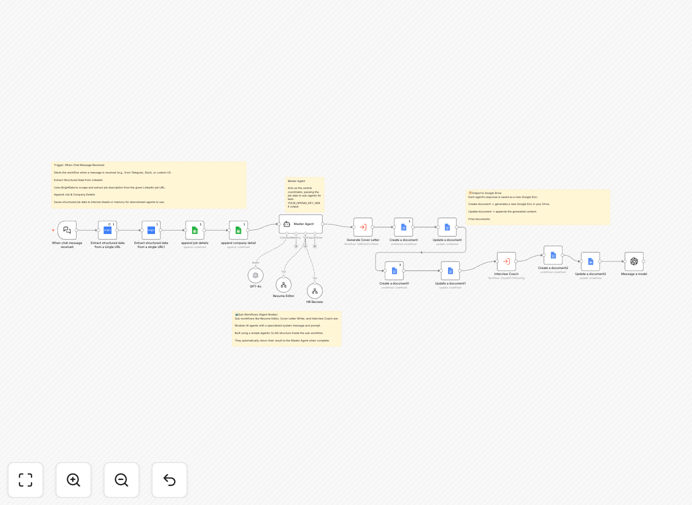
Visual diagram of an AI job application automation workflow connecting LinkedIn, AI analysis, and document creation in Google Docs

What This Workflow Does

Job searching is a time-consuming, repetitive process. Crafting a unique resume and cover letter for each application can take hours, leading to burnout and inconsistent quality. This automation solves that problem by turning a single LinkedIn job URL into a complete, personalized application package in minutes.

The workflow acts as your AI-powered career assistant. It extracts key details from a job posting—required skills, company values, role responsibilities—and uses multiple AI agents to generate a resume that highlights your matching experience, a compelling cover letter that addresses the specific hiring manager's needs, and a set of intelligent interview questions to help you prepare. All documents are automatically formatted and saved to your Google Drive, creating an organized portfolio of your applications.

This isn't just about saving time; it's about increasing your success rate. Tailored applications significantly outperform generic ones, and this system ensures every submission is optimized, giving you a competitive edge in a crowded job market.

How It Works

The workflow uses a multi-agent AI architecture, where specialized "agents" handle different parts of the task sequentially, mimicking a professional recruitment assistant's workflow.

Step 1: Input & Job Scraping

You provide a LinkedIn job URL. The workflow uses a web scraping service (like BrightData) to extract the full job description, title, company name, and key requirements. This data is cleaned and structured for the AI to process.

Step 2: AI Analysis & Strategy

The first AI agent analyzes the scraped job data. It identifies core competencies, technical keywords, soft skills, and company culture cues. It creates a "personalization strategy" outlining how your application should be framed.

Step 3: Resume Tailoring

A second AI agent takes your master resume (stored as a template) and the personalization strategy. It rewrites your professional summary, reorders bullet points to prioritize relevant experience, and injects keywords from the job description to ensure it passes through Applicant Tracking Systems (ATS).

Step 4: Cover Letter Generation

A third agent writes a unique cover letter. It doesn't just fill in blanks; it constructs a narrative that connects your background to the company's challenges, using tone and language pulled from the company's own website and the job ad.

Step 5: Interview Prep & Storage

A final agent generates a list of 10-15 likely interview questions based on the job role and your tailored resume. All three documents—the resume, cover letter, and question list—are then created as new Google Docs in a designated folder, ready for your final review and submission.

Pro tip: Maintain a "master" resume in Google Docs with all your experiences, skills, and achievements. The AI will pull from this comprehensive source to create targeted versions, ensuring you never forget to include a relevant accomplishment.

Who This Is For

This automation is ideal for active job seekers, career changers, recruitment agencies, and outplacement services. It's perfect for anyone applying to multiple roles who wants to maintain a high standard of personalization without the manual effort. Recruiters can also use it to quickly prepare candidate profiles for specific roles.

What You'll Need

  1. An n8n instance (Cloud or self-hosted).
  2. OpenAI API key (or another supported LLM provider) for the AI analysis and content generation.
  3. Google Cloud Platform (GCP) credentials with the Google Drive API enabled to create and store documents.
  4. A web scraping service API key (like BrightData) to extract data from LinkedIn job pages. (Note: Always comply with LinkedIn's Terms of Service).
  5. A master resume template saved in a consistent format (e.g., in Google Docs) that the AI can use as a source.

Quick Setup Guide

Import and configure this workflow in under 15 minutes to start automating your job applications.

  1. Download & Import: Click the "Download Template" button above. In your n8n interface, go to Workflows > Import from File and select the downloaded JSON file.
  2. Configure Credentials: In the n8n canvas, set up the following credentials:
    • OpenAI: Add your API key in the AI Agent nodes.
    • Google Drive: Set up OAuth 2.0 credentials to allow n8n to create documents in your Drive.
    • Web Scraping Service: Enter your API key for the HTTP Request node configured for scraping.
  3. Set Your Master Resume: Update the "HTTP Request" or "Google Docs" node that fetches your master resume template with the correct document ID or URL.
  4. Test the Trigger: Run the workflow once manually. Paste a LinkedIn job URL into the starting node's parameter and click "Execute Node". Check your Google Drive for the newly generated documents.
  5. Automate (Optional): Set the trigger to run on a schedule (e.g., daily) or connect it to a form where you or candidates can submit job links.

Important: Respect rate limits on the scraping service and LinkedIn. Use this automation for a reasonable number of personal applications. For high-volume commercial use, ensure you have the proper licensing and comply with all platform terms.

Key Benefits

Save 5-10 hours per week. Eliminate the manual, repetitive work of reformatting resumes and writing cover letters from scratch for every application.

Increase application quality and response rates. AI-tailored applications that speak directly to the job description are far more likely to get past ATS filters and catch a recruiter's eye.

Reduce human error and inconsistency. The automated process ensures every document is formatted correctly, includes all required information, and maintains a professional tone.

Get interview-ready instantly. By generating potential interview questions based on the specific job, you can begin preparing immediately, turning application time into productive practice time.

Build an organized application portfolio. All generated materials are automatically saved with clear filenames in a dedicated Google Drive folder, making it easy to track and reference your submissions.

Frequently Asked Questions

Common questions about AI job search automation and integration

An AI-powered job application assistant is an automation that uses artificial intelligence to streamline the job search process. It typically works by analyzing a job description from a platform like LinkedIn, then automatically generating personalized application materials like resumes and cover letters that match the specific requirements and keywords of that job.

Think of it as a virtual career coach that works 24/7. It handles the tedious parts of job hunting—researching the role, matching your skills, and drafting documents—so you can focus on networking and interview performance. The best systems, like this n8n template, go beyond simple templates and use multiple AI agents to create genuinely tailored content.

AI helps by parsing the job description to identify key skills, required experience, and company culture keywords. It then reformats your existing resume and crafts a cover letter that highlights your most relevant qualifications, using language that resonates with the hiring manager and applicant tracking systems (ATS). This increases the chances of your application getting noticed.

For example, if a job posting emphasizes "agile project management" and "cross-functional team leadership," the AI will prioritize those phrases in your resume's bullet points and weave them into the narrative of your cover letter. This level of customization, done manually, takes considerable time and is easy to overlook when applying to many jobs.

Yes, significantly. Automation ensures consistency, saves hours per application, and allows you to apply to more roles with higher-quality, tailored materials. By removing manual, repetitive tasks, you can focus on networking and interview preparation, leading to a more efficient and effective job search strategy.

The quantitative benefit is clear: you can apply to 3-5x more positions with the same time investment. The qualitative benefit is even greater: each application is optimized, which directly impacts the likelihood of landing an interview. Automated systems also reduce the fatigue that leads to rushed, lower-quality applications later in your search.

The main benefits include saving 5-10 hours per week on applications, ensuring every submission is customized, reducing human error, generating data-driven interview questions for preparation, and maintaining organized records of all applications and generated materials in a central location like Google Drive.

Beyond time savings, automation brings strategic advantages. It enforces a disciplined, repeatable process, provides a portfolio of your tailored applications for review, and gives you actionable insights (via the generated interview questions) into what the company is looking for in a candidate before you even speak to them.

  • Scale: Apply to more jobs without sacrificing quality.
  • Confidence: Walk into interviews prepared with company-specific questions.
  • Organization: All documents are auto-saved and easy to find.

No, you don't need to be a programmer. Tools like n8n use a visual, low-code interface where you connect pre-built apps (like Google Docs and OpenAI) with a drag-and-drop canvas. Basic comfort with technology and the ability to follow a setup guide for API keys is all that's required to get started.

The template provided is pre-built. You mainly need to configure a few API connections (which are step-by-step processes) and point the workflow to your resume template. Think of it like connecting Lego blocks rather than writing code. The visual interface makes it easy to see how data flows from LinkedIn, to the AI, and into your Google Drive.

When used correctly, yes. The AI acts as a powerful assistant for drafting and formatting. The critical step is always your personal review. You must verify all information for accuracy, ensure it truthfully represents your experience, and inject your unique voice and personality into the final documents before submitting them.

AI is a tool, not a replacement for your judgment. Use it to overcome writer's block, ensure keyword optimization, and maintain consistent formatting. However, you are ultimately responsible for the content. Always fact-check dates, job titles, and accomplishments. The final human touch—your personal story and passion—is what makes an application memorable.

Beyond application generation, you can automate sourcing candidates from multiple job boards, screening resumes against criteria, scheduling interviews, sending follow-up emails, collecting feedback from hiring teams, and updating your ATS or CRM. This frees up recruiters and hiring managers for high-value human interactions.

For example, an automated workflow could scrape new job postings that match your criteria, summarize them, and alert you. Another could parse incoming resumes, score them based on keywords, and automatically send a rejection or a scheduling link for a first interview. The goal is to automate the administrative overhead so talent professionals can focus on building relationships.

Absolutely. GrowwStacks specializes in building custom automation solutions for recruitment teams, career coaches, and outplacement services. We can design systems that integrate with your specific ATS, CRM, or internal databases, create branded document templates, and automate complex multi-step candidate engagement sequences.

While this free template is a great starting point for individuals, businesses often need more: bulk processing for multiple candidates, integration with Greenhouse or Lever, custom reporting dashboards, or white-labeled portals for clients. Our team can build a tailored system that fits your exact workflow, scales with your volume, and delivers measurable ROI by reducing time-to-hire and improving candidate quality.

  • Integrate directly with your existing recruitment software.
  • Create custom branding and document templates.
  • Build automated candidate communication sequences.
  • Generate analytics on application success rates.

Need a Custom Job Search Automation?

This free template is a starting point. Our team builds fully tailored automation systems for your specific business needs.