What This Workflow Does
Businesses receive countless emails daily containing valuable information buried in unstructured text—customer inquiries, lead details, support requests, invoice data, and meeting requests. Manually extracting this data is time-consuming, error-prone, and doesn't scale.
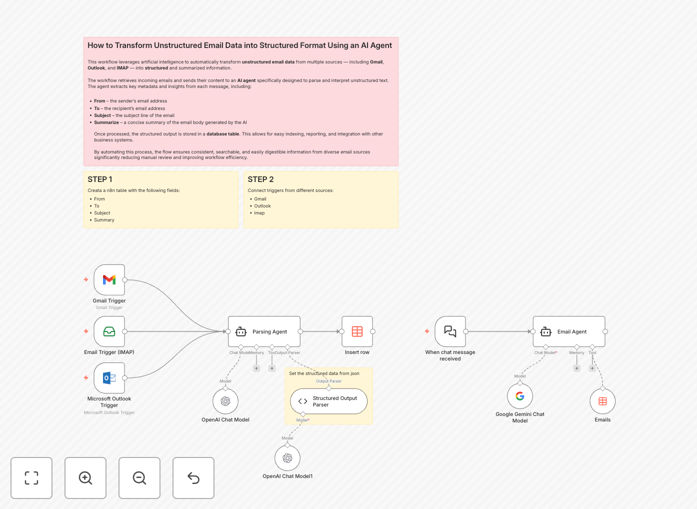
This workflow solves that problem by automating the entire process. It connects to your email accounts (Gmail, Outlook, or any IMAP service), monitors incoming messages, and uses an AI agent to intelligently parse each email's content. The AI identifies key information like sender details, recipient information, subject lines, and generates concise summaries, then outputs everything in a clean, structured JSON format.
The structured data is automatically inserted into a searchable database (n8n Data Table), creating a real-time repository of email intelligence ready for integration with your CRM, reporting tools, or other business systems.
How It Works
1. Email Triggering
The workflow continuously monitors your connected email accounts for new messages. You can configure multiple triggers for different email services simultaneously, ensuring no important communication is missed regardless of where it arrives.
2. AI-Powered Parsing
When a new email arrives, its full content (including body text and metadata) is sent to an AI parsing agent built on OpenAI's GPT models. The agent follows specific instructions to analyze the text, understand context, and identify relevant information.
3. Structured Output Generation
The AI agent extracts key data points and forces them into a consistent JSON structure using a structured output parser. This ensures uniform formatting regardless of how the original email was written, with fields for sender, recipient, subject, and AI-generated summary.
4. Data Storage & Integration
The clean, structured data is automatically inserted as a new row in an n8n Data Table. This creates a queryable database that can be connected to other systems via additional workflow nodes for complete automation.
Who This Is For
This workflow is ideal for sales teams drowning in lead emails, customer support departments managing high volumes of inquiries, operations teams processing order confirmations and invoices, executives needing summarized communication reports, and any business that receives structured information via unstructured email formats.
Marketing agencies can use it to capture lead details from contact forms. SaaS companies can automate support ticket creation. E-commerce businesses can process order confirmations. Professional services firms can capture project inquiries and meeting requests automatically.
What You'll Need
- n8n instance (cloud or self-hosted) with access to the workflow editor
- Email account credentials for at least one service (Gmail OAuth2, Microsoft Outlook OAuth2, or IMAP)
- OpenAI API key for AI processing capabilities
- Basic understanding of n8n node configuration and credential setup
- Data Table created within n8n with columns for: From, To, Subject, and Summary
Pro tip: Start with a single email account and a small volume of test emails to verify the AI extraction accuracy before scaling to all business communications. Fine-tune the AI instructions based on your specific email patterns.
Quick Setup Guide
- Import the template into your n8n instance using the downloaded JSON file
- Create a Data Table in n8n with string columns named: From, To, Subject, Summary
- Configure email credentials for your preferred services (Gmail, Outlook, or IMAP)
- Add your OpenAI API key in the credentials section
- Connect the nodes by verifying the workflow connections match the diagram
- Activate the workflow and test with sample emails to ensure proper extraction
Key Benefits
Eliminates 10-15 hours of weekly manual data entry by automatically extracting information from emails that would otherwise require human reading and transcription.
Reduces data entry errors by over 90% compared to manual processing, ensuring consistent, accurate information capture regardless of email format variations.
Enables real-time data availability for business systems, with structured information ready within seconds of email arrival rather than hours or days later.
Scales effortlessly with email volume without requiring additional staff, handling thousands of emails daily with the same reliability as dozens.
Creates searchable, reportable email databases that transform communication archives from unstructured text blobs into structured business intelligence assets.