What This Workflow Does
This automation solves the critical business problem of manually reviewing user-generated content—whether it's marketplace listings, forum posts, review comments, or support tickets. Manual moderation is slow, inconsistent, and doesn't scale with traffic spikes, leaving businesses vulnerable to brand damage and compliance violations.
The workflow uses OpenAI's GPT-4o to analyze incoming content against your specific policies, automatically classifying it as "approve," "flag," or "escalate." Flagged content triggers immediate notifications to your moderation team via Slack, while serious violations can generate escalation emails via Gmail. All decisions are logged for audit trails and compliance reporting.
By implementing this system, businesses can process hundreds of content items per hour with consistent policy application, reduce moderation labor costs by 70-90%, and maintain safer online environments that build user trust and protect brand reputation.
How It Works
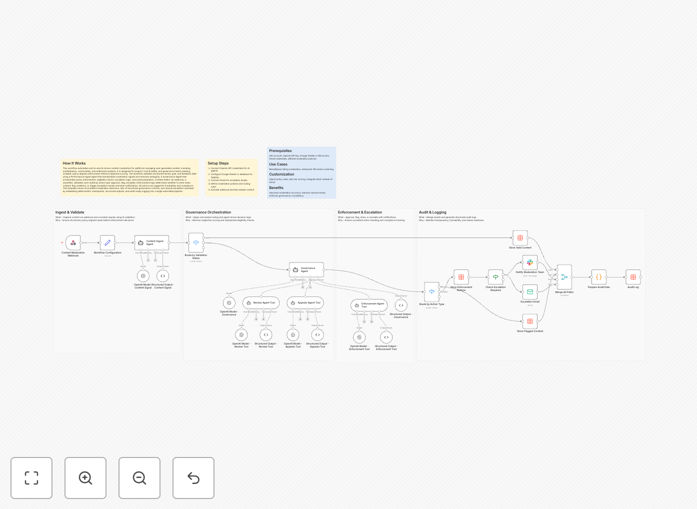
The automation follows a structured pipeline that ensures every piece of content receives appropriate attention based on its risk level.
1. Content Ingestion & Classification
New user content arrives via webhook from your platform. The workflow extracts the text, metadata, and context, then sends it to OpenAI GPT-4o with your specific moderation guidelines. The AI analyzes for policy violations, toxicity, spam patterns, and appropriateness.
2. Risk Assessment & Decision Routing
Based on the AI analysis, each item receives a risk score and classification. Clean content is automatically approved and stored. Borderline content is flagged for human review. Severe violations trigger immediate escalation protocols.
3. Team Notification & Action
Flagged items generate detailed Slack messages to your moderation channel with the content snippet, violation reason, and quick-action buttons. Escalated items automatically generate formatted Gmail alerts to senior team members with all context for immediate action.
4. Audit Logging & Reporting
Every decision—whether automated or human-reviewed—is logged with timestamps, decision reasons, and action taken. This creates a complete audit trail for compliance requirements and enables continuous improvement of your moderation policies.
Who This Is For
This template is ideal for product managers, community managers, and trust & safety teams at marketplaces, social platforms, SaaS companies, and any business handling user-generated content. It's particularly valuable for:
- Marketplaces screening product listings and reviews
- Community platforms moderating forum posts and comments
- HR departments monitoring internal communication channels
- Customer support teams filtering inappropriate support tickets
- Content publishers managing user submissions and comments
What You'll Need
- An n8n instance (cloud or self-hosted)
- OpenAI API credentials with GPT-4o access
- Slack workspace with appropriate channel permissions
- Gmail account or Google Workspace for escalation emails
- Your documented content moderation policies and guidelines
- A database or Google Sheets for logging decisions (optional but recommended)
Quick Setup Guide
Get this automation running in under 30 minutes with these simple steps:
- Import the template: Download the JSON file above and import it into your n8n instance.
- Configure credentials: Add your OpenAI API key, Slack bot token, and Gmail credentials to the respective nodes.
- Customize policies: Edit the OpenAI prompt node with your specific content guidelines and violation categories.
- Set up notifications: Update Slack channel IDs and Gmail recipient addresses for your team structure.
- Test with sample content: Send test content through the webhook to verify classification and notification flow.
- Connect to your platform: Replace the webhook trigger with your actual content source (API, database, form submissions).
Pro tip: Start with conservative AI settings and gradually expand as you build confidence. Implement a "human-in-the-loop" phase where all AI decisions are reviewed for the first week to calibrate accuracy before full automation.
Key Benefits
Scale moderation instantly without hiring: Process thousands of content items daily with the same infrastructure cost, eliminating the need for large moderation teams during traffic surges or platform growth phases.
Ensure consistent policy application 24/7: Remove human subjectivity and fatigue from moderation decisions, applying your guidelines uniformly across all time zones and content types without variation.
Reduce response time from hours to seconds: Flag inappropriate content immediately upon submission rather than hours later, preventing viral spread of violations and protecting your community experience.
Create audit-ready compliance records: Automatically generate detailed logs of every moderation decision with timestamps, reasoning, and actions—essential for regulatory compliance and legal protection.
Free your team for strategic work: Redirect human moderators from routine screening to handling complex edge cases, policy development, and community engagement that adds real business value.