GitHub Webhooks DevOps n8n Automation

Monitor Multiple GitHub Repos via Webhook

Get real-time notifications for commits, pushes, and pull requests across all your repositories without constant polling.

Download Template JSON · n8n compatible · Free
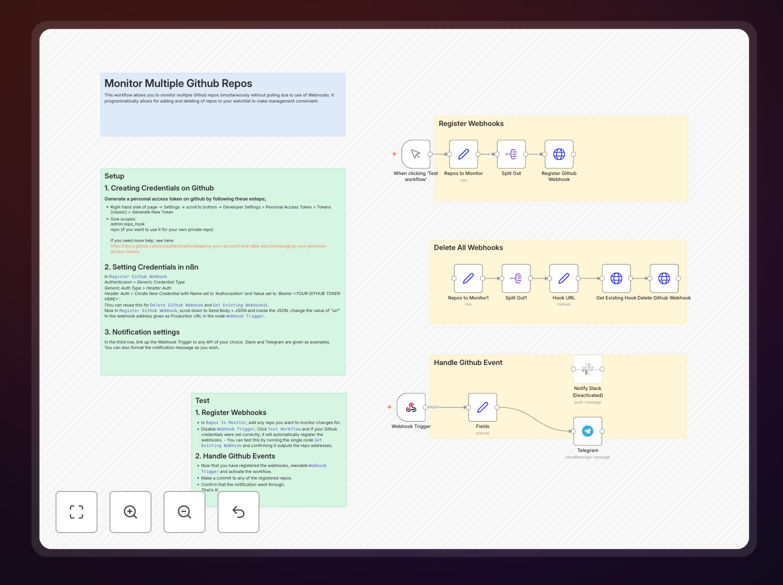
GitHub multi-repository monitoring workflow diagram showing webhook integration

What This Workflow Does

This automation solves the common problem of manually tracking changes across multiple GitHub repositories. Instead of constantly checking each repo or setting up individual notifications, this workflow uses GitHub webhooks to monitor all your repositories simultaneously. Whenever a commit, push, pull request, or other event occurs, you receive instant notifications through your preferred channels like Slack, email, or Microsoft Teams.

The system programmatically manages webhook registration and removal, making it easy to add or remove repositories from your watchlist without manual configuration. This eliminates the resource-intensive polling approach, where systems repeatedly check for changes, and replaces it with efficient, event-driven notifications that save bandwidth and server resources while providing faster alerts.

How It Works

1. Webhook Registration

The workflow automatically registers webhooks with your specified GitHub repositories using a personal access token. It sets up endpoints that GitHub will call whenever specific events occur, creating a direct communication channel between GitHub and your notification system.

2. Event Listening & Processing

When GitHub sends a webhook payload (triggered by repository activity), the workflow receives it instantly. The system parses the JSON payload to extract relevant information: who made the change, what was changed, which repository was affected, and the type of event.

3. Intelligent Notification Routing

Based on configurable rules, the workflow determines where and how to send notifications. You can set up different channels for different types of events—for example, critical commits might go to a team channel while routine updates go to a dedicated notifications channel.

4. Dynamic Repository Management

The workflow includes functionality to programmatically add or remove repositories from monitoring. This means you can update your watchlist through a simple interface without manually configuring each webhook in GitHub's settings.

Who This Is For

This automation is ideal for development teams, engineering managers, DevOps professionals, and organizations managing multiple codebases. It's particularly valuable for agencies serving multiple clients, companies with microservices architectures, open-source project maintainers, and any team that needs visibility into code changes across different repositories. If you're tired of missing important commits or spending time manually checking repositories, this workflow provides the automated oversight you need.

What You'll Need

  1. A GitHub account with admin access to the repositories you want to monitor
  2. A GitHub personal access token with repo and admin:repo_hook permissions
  3. An n8n instance (cloud or self-hosted) to run the workflow
  4. Destination channels for notifications (Slack, Teams, Discord, email, etc.)
  5. A publicly accessible webhook URL (provided by n8n when you activate the workflow)

Quick Setup Guide

  1. Download and import the template JSON file into your n8n instance.
  2. Configure GitHub credentials by creating a credential with your personal access token in the HTTP Request nodes.
  3. Update the webhook URL in the Register GitHub Webhook node with your n8n production URL.
  4. Add repository URLs to the "Repos to Monitor" list in the workflow.
  5. Connect notification channels by configuring Slack, Telegram, or other nodes with your destination details.
  6. Test the workflow by making a commit to one of your monitored repositories and verifying the notification arrives.

Pro tip: Start by monitoring just 1-2 repositories to verify everything works correctly before adding your entire portfolio. This helps you fine-tune notification formats and routing rules with minimal noise.

Key Benefits

Real-time awareness without constant checking: Get notified within seconds of any repository activity instead of periodically checking multiple repos throughout the day. This ensures you never miss critical changes while freeing up mental bandwidth for actual development work.

Reduced infrastructure load: Webhooks eliminate the need for polling, which can make hundreds of API calls per hour. This significantly reduces bandwidth usage, avoids GitHub API rate limits, and minimizes server resource consumption compared to traditional polling approaches.

Centralized monitoring across all projects: Instead of managing notifications separately for each repository, get a unified view of all activity in one place. This is especially valuable for teams managing client projects, internal tools, and open-source contributions simultaneously.

Automated compliance tracking: Maintain automatic audit trails of all code changes with timestamps, user information, and change details. This documentation is invaluable for security reviews, compliance requirements, and post-incident investigations.

Scalable team coordination: As your team grows or you take on more projects, the system scales effortlessly. New repositories can be added programmatically, and notification rules can be adjusted to match evolving team structures and workflows.

Frequently Asked Questions

Common questions about GitHub automation and integration

Webhooks provide real-time, event-driven notifications instantly when an action occurs in your repository, eliminating the need for constant polling. This reduces server load, saves bandwidth, and ensures you get notifications within seconds rather than waiting for the next polling interval.

Polling requires your system to repeatedly check for changes, which can miss events between checks and consume unnecessary resources. Webhooks are more efficient, reliable, and faster for monitoring dynamic systems like GitHub repositories where changes can happen frequently.

  • Instant notification vs. delayed discovery
  • Reduced API calls and bandwidth usage
  • More reliable event capture

Monitoring multiple repositories simultaneously gives teams complete visibility into code changes across all projects. This enables faster response to critical commits, helps maintain code quality standards, and ensures all team members stay informed about updates.

For example, when a developer fixes a security vulnerability in a shared library, all teams using that library can be notified immediately. This proactive approach prevents issues from propagating through dependent projects and helps coordinate updates across your entire codebase.

  • Cross-project dependency awareness
  • Faster incident response
  • Improved team coordination

Key events to monitor include pushes (code commits), pull request creation and merges, issue creation and updates, releases, and deployment statuses. Push events track all code changes, pull request events help with code review workflows, and issue events keep teams aligned on bug reports and feature requests.

The specific events you monitor depend on your team's workflow—some teams focus on deployment triggers while others prioritize code review notifications. Start with push and pull request events, then expand based on what information provides the most value to your specific development process.

  • Push events for all code changes
  • Pull request events for review workflows
  • Issue events for bug tracking

Yes, GitHub webhooks can integrate with virtually any tool your team uses. Common integrations include Slack or Microsoft Teams for instant notifications, Jira or Trello for automatically creating or updating tickets, email systems for formal notifications, and CI/CD platforms like Jenkins or CircleCI to trigger automated builds.

This creates a connected development ecosystem where GitHub activities automatically update all relevant systems without manual intervention. For instance, when a pull request is merged, it can automatically create a deployment ticket in Jira and post a notification in your team's Slack channel.

  • Communication tools (Slack, Teams)
  • Project management (Jira, Trello)
  • CI/CD pipelines (Jenkins, CircleCI)

Automated GitHub monitoring creates comprehensive audit trails by logging every repository event with timestamps, user information, and change details. This is essential for compliance requirements like SOC 2, HIPAA, or GDPR where you need to demonstrate who changed what and when.

These automated logs ensure no events are missed, provide searchable records for investigations, and help identify unauthorized access or policy violations quickly. For regulated industries, this automated documentation can significantly reduce the manual effort required for compliance reporting and audits.

  • Automatic timestamped event logging
  • User attribution for all changes
  • Searchable compliance records

Key security considerations include using HTTPS endpoints for webhooks, implementing secret tokens to verify payload authenticity, restricting webhook permissions to necessary events only, regularly rotating access tokens, and monitoring webhook delivery failures.

Always validate incoming webhook payloads, never trust unverified data, and ensure your receiving endpoint has proper authentication and rate limiting to prevent abuse. For sensitive repositories, consider implementing additional validation logic to ensure only authorized events trigger notifications or actions.

  • Use HTTPS and secret tokens
  • Restrict to necessary permissions
  • Monitor for delivery failures

Small teams benefit significantly from GitHub automation as it acts as a force multiplier, allowing limited personnel to manage multiple projects effectively. Automation handles routine notifications, status updates, and coordination tasks, freeing developers to focus on coding.

It ensures nothing slips through the cracks, maintains consistent processes as the team grows, and provides professional-grade workflow management without requiring dedicated DevOps staff. Even solo developers find value in automated monitoring to maintain oversight while concentrating on development work.

  • Force multiplier for limited teams
  • Consistent processes as you grow
  • Professional workflows without overhead

Yes, GrowwStacks specializes in building custom GitHub automation solutions tailored to your specific development workflows, team structure, and integration needs. We can create systems that monitor your unique repository configurations, integrate with your existing tool stack, implement custom notification logic, and scale with your team's growth.

Our solutions help development teams work more efficiently with automated coordination across all their GitHub activities. Whether you need specialized event filtering, integration with proprietary tools, or complex multi-team notification routing, we can build a system that fits your exact requirements.

  • Tailored to your workflow
  • Integration with your tool stack
  • Scalable with your team growth

Need a Custom GitHub Automation?

This free template is a starting point. Our team builds fully tailored automation systems for your specific business needs.