What This Workflow Does
This automation creates a virtual, AI-powered Revenue Operations (RevOps) team. It tackles the common challenge of siloed revenue data and slow, manual analysis. Instead of spending days pulling reports from your CRM, marketing platforms, and financial tools, this workflow gives you an instant, strategic assessment of your revenue health and growth opportunities.
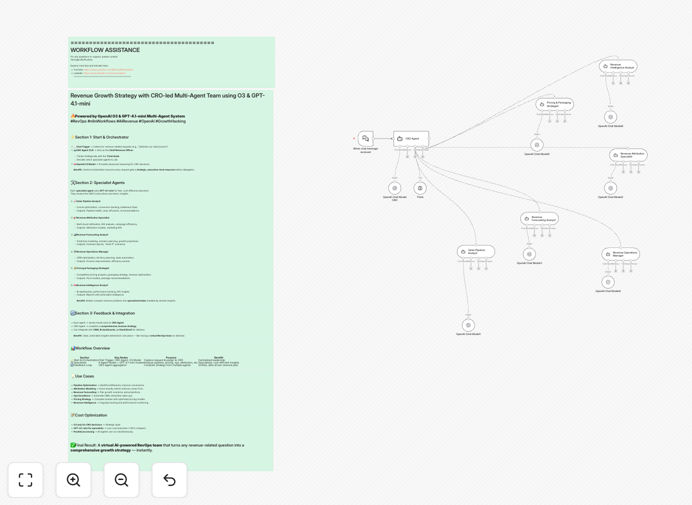
At its core, a central "Chief Revenue Officer" AI agent (powered by OpenAI O3) receives a business question—like "How can we improve our Q4 conversion rate?" or "Why is our customer acquisition cost rising?" It then intelligently delegates tasks to a team of six specialist AI agents, each using the faster, more cost-effective GPT-4.1-mini model. These specialists analyze different facets of your revenue engine in parallel, from sales pipeline bottlenecks to marketing attribution and pricing strategy, before the CRO agent synthesizes their findings into a coherent, actionable plan.
The result is a system that transforms vague business questions into data-driven revenue strategies, automating the analytical heavy lifting that typically requires a cross-functional team.
How It Works
The workflow is built on a multi-agent architecture, mimicking a high-performing revenue department.
1. Strategic Orchestration (CRO Agent)
The process begins with a user prompt via a Chat Trigger. The OpenAI O3-powered CRO Agent acts as the executive, using its advanced reasoning to interpret the request, define the strategic objectives, and determine which specialist agents are needed to answer the question comprehensively.
2. Parallel Specialist Analysis
The CRO Agent simultaneously activates the relevant specialist agents. Each agent has a defined role and accesses relevant data or instructions:
- Sales Pipeline Analyst: Examines funnel stages, identifies drop-off points, and calculates conversion rates.
- Revenue Attribution Specialist: Evaluates marketing touchpoints to model which channels drive the most valuable deals.
- Revenue Forecasting Analyst: Runs predictive models based on historical data and current pipeline to project future revenue.
- Revenue Operations Manager: Reviews CRM hygiene, sales process efficiency, and automation opportunities.
- Pricing & Packaging Strategist: Analyzes competitor pricing, customer segments, and value metrics to recommend optimizations.
- Revenue Intelligence Analyst: Compiles performance dashboards and tracks KPIs against targets.
3. Synthesis & Delivery
Each specialist returns its findings to the CRO Agent. The CRO Agent then synthesizes these parallel analyses, identifies overarching themes and conflicts, and prioritizes recommendations. The final, consolidated strategy can be delivered via email, posted to a Slack channel, saved to a Google Doc, or even used to trigger other automations—like updating a forecast in your CRM or adjusting a budget in your accounting software.
Pro tip: Start by connecting just one or two data sources (like your CRM). You can expand the integrations later. The real power is in the AI's ability to reason across the data you provide, even if it's not everything at first.
Who This Is For
This template is designed for business leaders and operations teams who need to move faster than their data allows.
- Revenue & Sales Leaders (CROs, VPs of Sales): Get instant, holistic views of pipeline health and forecasting without waiting for weekly reports.
- Marketing Operations Managers: Understand the true ROI of campaigns and optimize spend based on multi-touch attribution.
- Finance & Operations Teams: Automate revenue reporting, scenario modeling, and integrate financial data with sales activity.
- Startups & Scale-ups: Access enterprise-grade revenue intelligence without building a large, expensive RevOps team from scratch.
- Consultants & Agencies: Provide clients with deep, automated revenue analysis as a service, differentiating your offerings.
What You'll Need
- An n8n instance: Either self-hosted or a cloud account.
- OpenAI API keys: One for the O3 model (for the CRO Agent) and one for GPT-4.1-mini (for the specialist agents).
- Access to your data sources: API keys or credentials for the systems you want to analyze (e.g., Salesforce, HubSpot, Google Analytics, Stripe, your data warehouse).
- A clear business question: Know what you want to optimize. "Increase win rate," "reduce CAC," or "improforecast accuracy" are perfect starters.
Quick Setup Guide
You can have this virtual RevOps team running in under 30 minutes.
- Download & Import: Click the "Download Template" button and import the JSON file into your n8n instance.
- Configure API Credentials: In the workflow settings, add your OpenAI API keys for both the O3 and GPT-4.1-mini nodes.
- Connect Your Data (Optional but Recommended): Replace the placeholder "Sticky Note" nodes with actual trigger nodes from your apps. For example, connect a "Schedule Trigger" to run the analysis weekly, or a "Webhook" to trigger it from your dashboard.
- Customize Agent Instructions: Review the "System Prompt" in each AI Agent node. Tweak them to reflect your specific business context, metrics, and goals.
- Test & Deploy: Run the workflow once with a test question. Check the results in the "CRO Final Report" node. Once satisfied, activate the workflow.
Key Benefits
Turn Weeks of Analysis into Minutes: What traditionally requires cross-departmental meetings and manual data crunching is now an automated, on-demand report. Get strategic insights instantly, not quarterly.
Break Down Data Silos: The multi-agent system inherently connects insights from sales, marketing, finance, and operations, providing a single source of truth for revenue performance.
Optimize AI Cost & Performance: By using the expensive O3 model only for high-level orchestration and the cheaper GPT-4.1-mini for execution, you get sophisticated reasoning without prohibitive costs.
Scale Your Strategic Capacity: This isn't just a report generator; it's a force multiplier. It allows your human team to focus on executing the strategy rather than spending all their time building it.
Future-Proof Your RevOps: The modular design means you can easily add new specialist agents (e.g., a "Churn Risk Analyst") or connect new data sources as your business evolves.