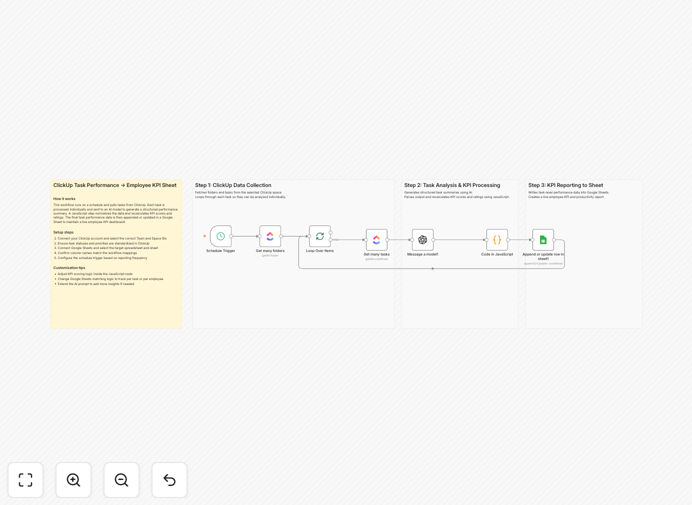
What This Workflow Does
Manual employee performance reviews are time‑consuming, subjective, and often lag behind real‑time work. This automation solves that by turning ClickUp task data into actionable KPIs automatically.
The workflow runs on a schedule, fetching tasks from ClickUp folders, sending them to GPT‑4.1 for structured evaluation, and writing the results—including productivity scores, completion rates, and quality insights—into a Google Sheets dashboard. Managers get a continuously updated view of team performance without manual data crunching.
It transforms raw task lists into quantified metrics: who’s exceeding expectations, who’s falling behind, and where coaching or resources are needed. This shifts performance management from periodic, stressful reviews to continuous, data‑driven insight.
How It Works
Step 1: Scheduled Data Collection
A Schedule Trigger starts the workflow daily or weekly. It connects to ClickUp and retrieves all tasks from specified spaces or folders. The Loop Over Items node iterates through each folder to ensure every task is processed.
Step 2: AI‑Powered Analysis
Each task’s details—title, description, status, assignee, due date, comments—are sent to GPT‑4.1 via the OpenAI node. The AI generates a summary, assigns a preliminary performance score, and highlights key patterns (e.g., “consistently meets deadlines,” “requires frequent revisions”).
Step 3: Score Standardization & Output
A JavaScript node cleans and standardizes the AI output, converting qualitative notes into numerical KPIs (1‑10 scale). It also flags overdue tasks and high‑priority items. Finally, the Google Sheets node appends or updates a row for each employee, building a real‑time dashboard.
Who This Is For
This template is ideal for:
- Team Leads & Managers who need objective performance data without manual tracking.
- HR Departments seeking automated, bias‑reduced insights for promotion and compensation decisions.
- Remote‑Work Companies that rely on digital task management and need visibility into distributed team productivity.
- Startups & Scale‑ups where rapid growth makes manual reviews impractical.
- Consulting & Service Firms that bill based on deliverables and need to monitor project execution efficiency.
What You'll Need
- A ClickUp account with tasks organized in spaces/folders.
- Google Sheets set up with a sheet ready for KPI data (columns: Employee, Date, Task Count, Completion Rate, AI Score, Summary).
- Access to GPT‑4.1 (OpenAI API key or equivalent AI service).
- An n8n instance (cloud or self‑hosted) with the ClickUp, OpenAI, and Google Sheets nodes installed.
- Basic understanding of your desired KPIs (what metrics matter for your team).
Quick Setup Guide
Import and configure this workflow in under 15 minutes:
- Download the template using the button above and import it into your n8n workspace.
- Connect your ClickUp account in the first node, selecting the space/folder containing employee tasks.
- Set up your OpenAI credentials in the Message a Model node, adjusting the prompt if you want different evaluation criteria.
- Link your Google Sheets in the final node, specifying the sheet and tab where KPI data should land.
- Adjust the schedule—set the trigger to run daily for real‑time dashboards or weekly for summary reports.
- Test with a single folder to verify data flows correctly, then expand to all relevant spaces.
Pro tip: Customize the AI prompt to evaluate task quality, collaboration, and initiative—not just completion. Add criteria like “mentions in comments,” “attachments added,” or “complexity level” to get richer insights.
Key Benefits
Save 5–10 hours per month per manager on performance data collection and manual reporting. The workflow does the gathering, analysis, and logging automatically.
Reduce bias in evaluations by using AI‑generated scores based on actual task data, not subjective impressions.
Enable proactive coaching with real‑time dashboards that show who’s struggling with deadlines or complexity, allowing timely support.
Improve retention & alignment by recognizing high performers faster and aligning individual outputs with company goals.
Scale performance tracking across large or distributed teams without adding administrative overhead.